
Most business owners treat Google like a black box. You publish a page, you wait, and either traffic shows up or it doesn’t. When it doesn’t, it feels random.
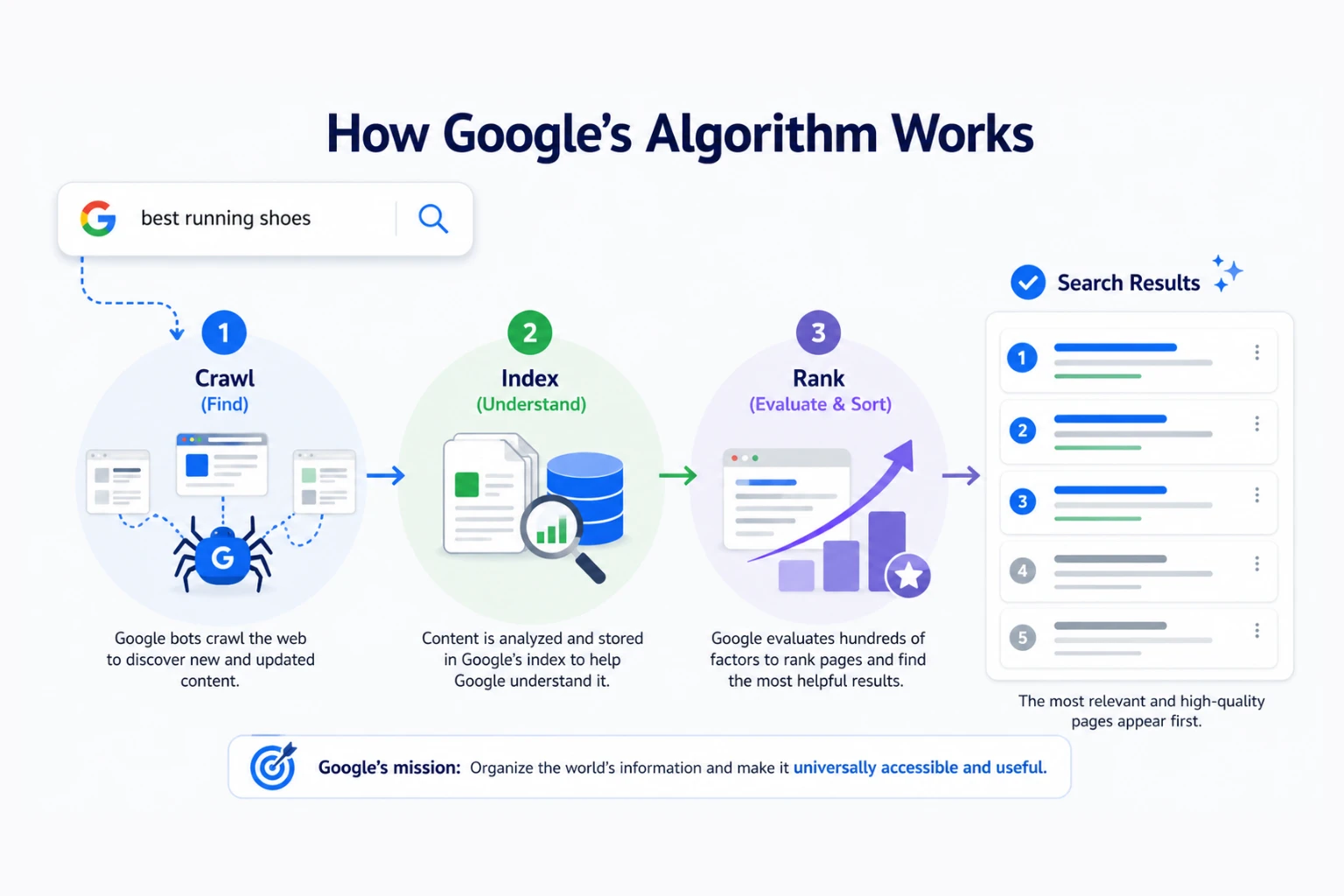
It isn’t. If you’ve ever wondered how does Google’s algorithm work, the honest answer is that it follows a logical process, even if the exact details stay hidden. Google isn’t guessing. It’s running a system built to find the single most useful page for every search, out of trillions of options.
You don’t need to be technical to understand that system. And once you do, a lot of SEO stops feeling like luck and starts feeling like something you can actually influence.
What is Google’s algorithm?
Google’s algorithm is the system Google uses to decide which pages to show for a search, and in what order. Every time someone types a query, it scans its index of pages, weighs a long list of signals, and ranks the results it believes best answer the question.
Calling it one algorithm is a simplification. It’s really many systems working together, each handling a different part of the job. Google keeps the exact recipe private, but it has been open about the broad categories that matter: relevance, quality, usability, and context. The goal underneath all of it is simple. Google is trying to match a person’s intent with the most helpful page available.
That framing matters more than any single tactic. Once you see the algorithm as a matching system rather than a scoring trick, the rest of SEO starts to make sense.
How Google’s algorithm works in three stages
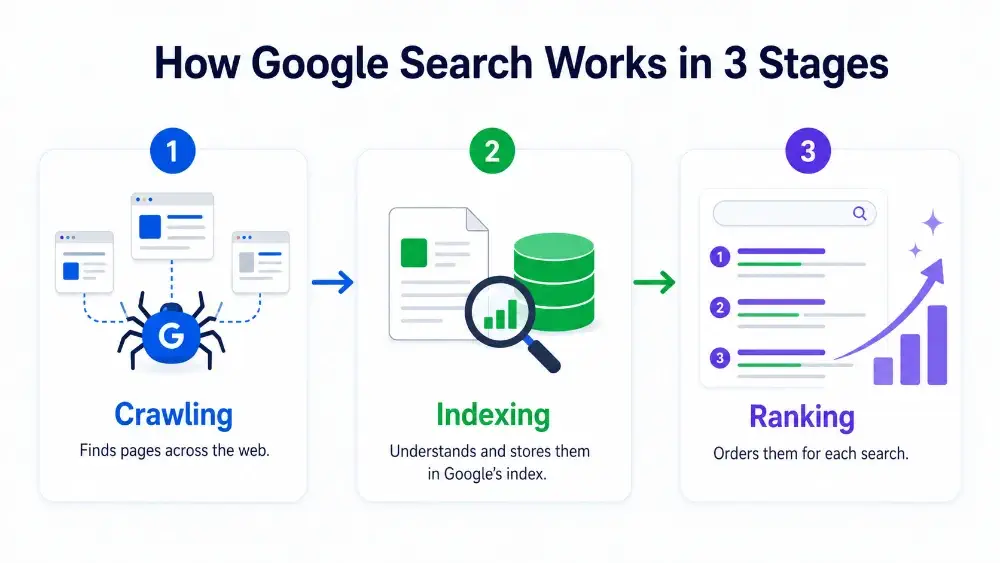
Before any ranking happens, a page has to clear two earlier steps. Google describes the whole process in three stages: crawling, indexing, and ranking. Skip the first two and ranking never enters the picture.
Crawling: Google finds your pages
Google uses automated programs called crawlers, often referred to as Googlebot, to discover pages across the web. They follow links from one page to the next and check sitemaps to find new and updated content. Picture it as exploring a city by walking every connected street.
The practical lesson is blunt. If nothing links to a page and it’s not in your sitemap, Google may never find it. Pages buried deep in your site, or blocked by messy navigation, can sit there invisible for months. Discovery has to happen before anything else can.
Indexing: Google understands and stores them
Once a page is found, Google analyzes it to work out what it’s about. It reads the text, identifies the topics and entities involved, and decides whether the page is worth storing in its index. This is where Google forms its understanding of the page, not as a human sees it, but as a set of topics and relationships.
Here’s the part people miss: crawled does not mean indexed. Thin, duplicate, or confusing pages can get skipped at this stage, which means they will never appear in results no matter how strong the rest of your site is. This is where a clean technical foundation earns its keep. A proper technical SEO audit usually surfaces the exact issues holding pages out of the index.
Ranking: Google decides the order
When someone searches, Google pulls relevant pages from its index and orders them by how well they answer the query. This is the part most people mean when they ask how the algorithm works. It’s also the part with the most moving pieces, because Google weighs dozens of signals at once to choose a winner for that specific search.
Two things are worth holding onto here. Ranking is query by query, not a fixed leaderboard. And it happens in a fraction of a second, every single time.
The ranking factors that actually matter
Google reportedly uses hundreds of signals, and trying to chase all of them is a waste of time. A handful do most of the heavy lifting. These are the categories worth your attention.
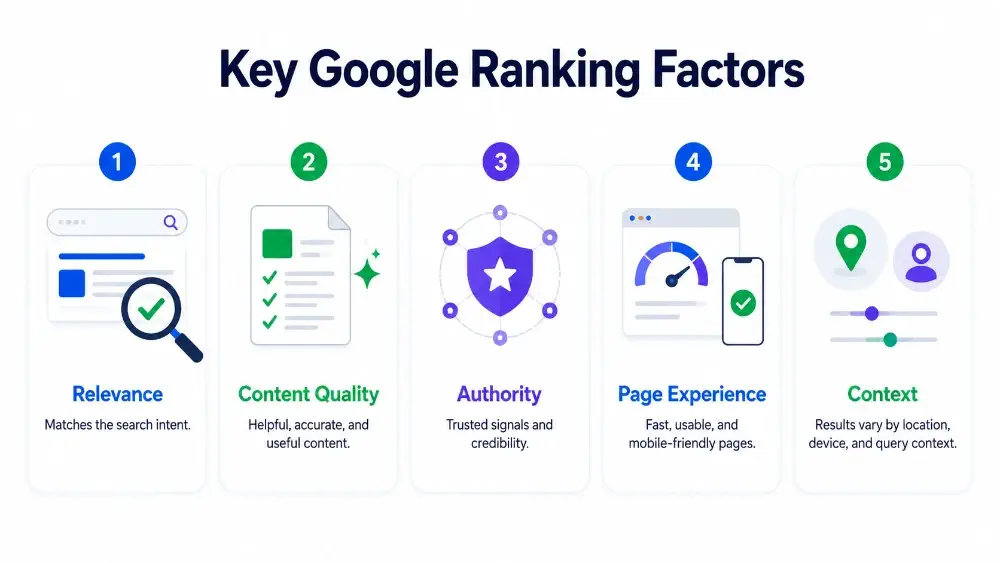
- Relevance. Does the page actually match the search? Google reads your titles, headings, and content to confirm the page is about the topic, not just that it mentions a keyword a few times.
- Content quality. Helpful, accurate, in-depth content built for people tends to win. Pages that exist only to rank tend to lose, especially after major updates.
- Authority. Links from other trusted sites act as votes of confidence. The more relevant and credible the source, the more weight the link carries. This is the foundation of domain authority, a useful way to gauge how much trust your site has earned over time.
- Page experience. Speed and usability count. Google measures part of this through Core Web Vitals, which track how fast and stable your pages feel to real visitors.
- Context. Location, language, and device shape what people see. A search for “coffee shop” returns different results in Vancouver than in Toronto.
These signals split into two groups: what’s on your page and what happens off it. If that distinction feels fuzzy, our breakdown of on-page vs off-page SEO lays it out clearly. Both groups matter, and the balance between them is part of what makes some keywords harder to win than others. Tools that estimate keyword difficulty are really estimating how strong the competing pages are on these same signals.
How AI is changing the algorithm in 2026
The biggest shift in recent years is AI moving from behind the scenes to the front of the results page.
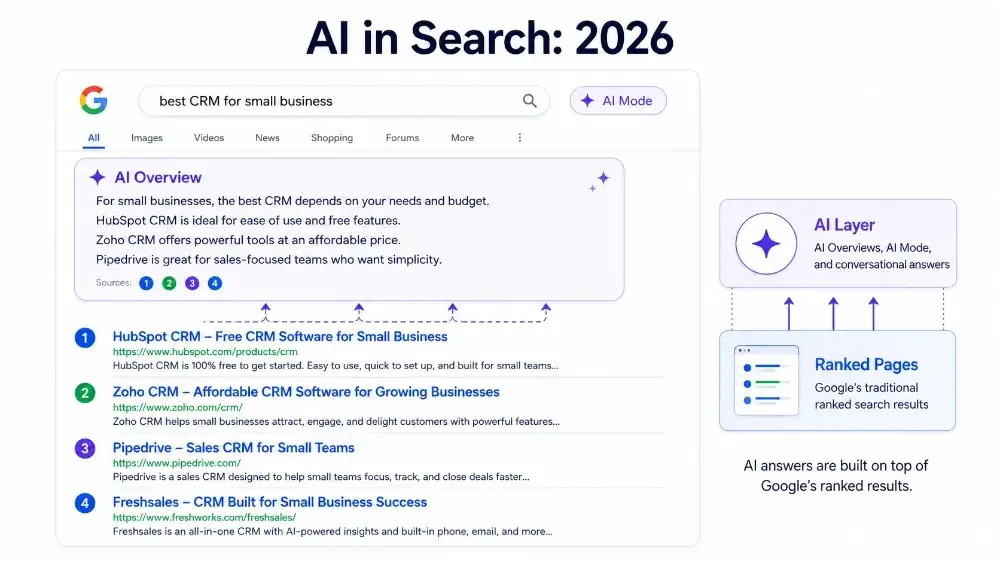
Google has used machine learning in ranking for a long time, through systems like RankBrain and BERT that help it understand the meaning behind a query instead of matching words literally. That part isn’t new. What’s new is what searchers now see. AI Overviews summarize answers at the top of many results, and AI Mode can run a full conversational search session. Both pull from the same indexed pages Google has always ranked. They don’t replace the algorithm. They sit on top of it.
For your site, the takeaway is steadier than the headlines suggest. The content that earns a spot in an AI Overview is the same content that ranks well: clear, well-structured, genuinely useful pages from sources Google trusts. Google leans heavily on a principle it calls E-E-A-T, short for experience, expertise, authoritativeness, and trustworthiness. It isn’t a single score you can game. It’s a pattern Google looks for across your whole site, built from real signals like helpful content, credible mentions, and a consistent track record on a topic.
So the AI era doesn’t change the assignment. It raises the bar on doing the assignment well.
Why the algorithm keeps changing
Google makes thousands of small adjustments every year. Most go completely unnoticed. A few times a year it rolls out a core update, a broader change that can noticeably move rankings, and those get announced publicly.
This is why sites sometimes drop without any obvious technical error. The page didn’t break. Google’s judgment of what deserves to rank shifted. It’s also why short-term tricks fail. Anything built to manipulate the algorithm rather than serve the reader tends to get corrected on the next update, often painfully.
The pattern across two decades of updates is remarkably consistent. Google keeps rewarding the same thing: useful content that genuinely answers the search, from sites people trust. Tactics that align with that survive the updates. Tactics that fight it don’t. Once you internalize that, you stop reading every algorithm rumor as a fire drill.
What this means for your website
Here’s the part most explainers skip. Understanding the algorithm only matters if it changes what you do.
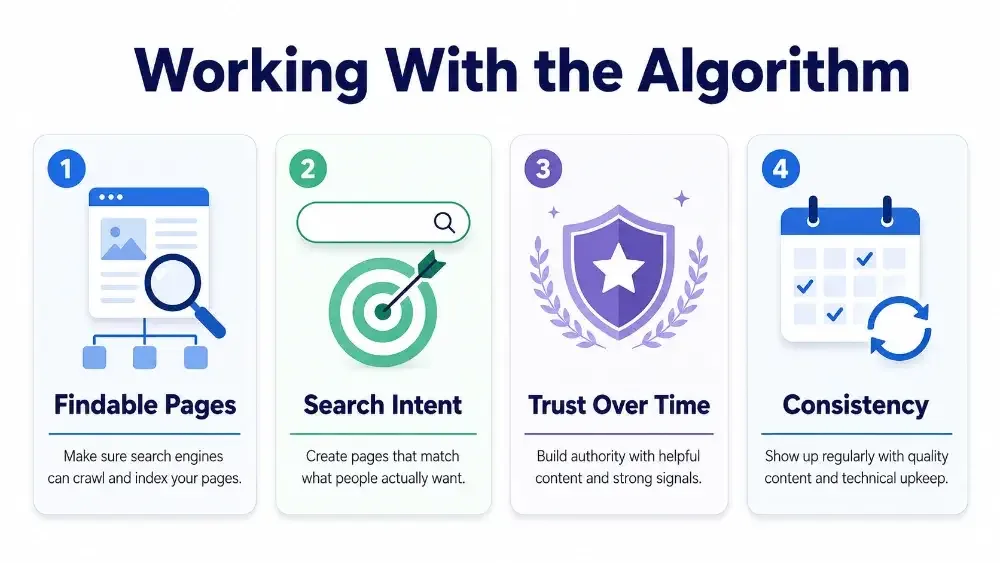
You don’t need to track every signal or react to every update. You need to get the fundamentals right and keep them right:
- Make sure Google can find and index your pages. No technical roadblocks, clean internal links, an up-to-date sitemap.
- Match real search intent. Build pages that answer what people are actually searching for, not what you wish they would search for.
- Earn trust over time. Quality content, credible links, and a site experience that doesn’t frustrate people.
- Play the long game. SEO takes time, and the businesses that win are the ones that stay consistent instead of chasing the latest hack.
Do those things and you stop fighting the algorithm. You start working with it. That’s the entire point of understanding how it works in the first place. The mechanics are interesting, but the behavior they reward is what actually grows your traffic.
Want help putting this into practice?
Knowing how the algorithm works is one thing. Building a site that consistently earns rankings is another. If you’d rather have a clear plan than guess your way through it, book a free 30-minute strategy call. No pitch, no pressure, just a straight read on where your site stands and what to fix first. Book your free call.
