
Most SEO advice online treats search engine optimization like a two-team rivalry: on-page on one side, off-page on the other, pick a winner. That framing is wrong, and it’s part of the reason so many small businesses pour money into the wrong work first.
The actual difference between on-page and off-page SEO is simple. On-page SEO is everything you do on your website to make it rank. Off-page SEO is everything that happens off your website that influences how Google sees you. But there’s a third pillar most articles skip over or bury in a footnote: technical SEO. And for most small businesses, it’s the one that needs attention first.
Here’s how the three pillars actually fit together, where each one moves the needle, and how to figure out which one your business should be investing in right now.
The three pillars of SEO, in one paragraph
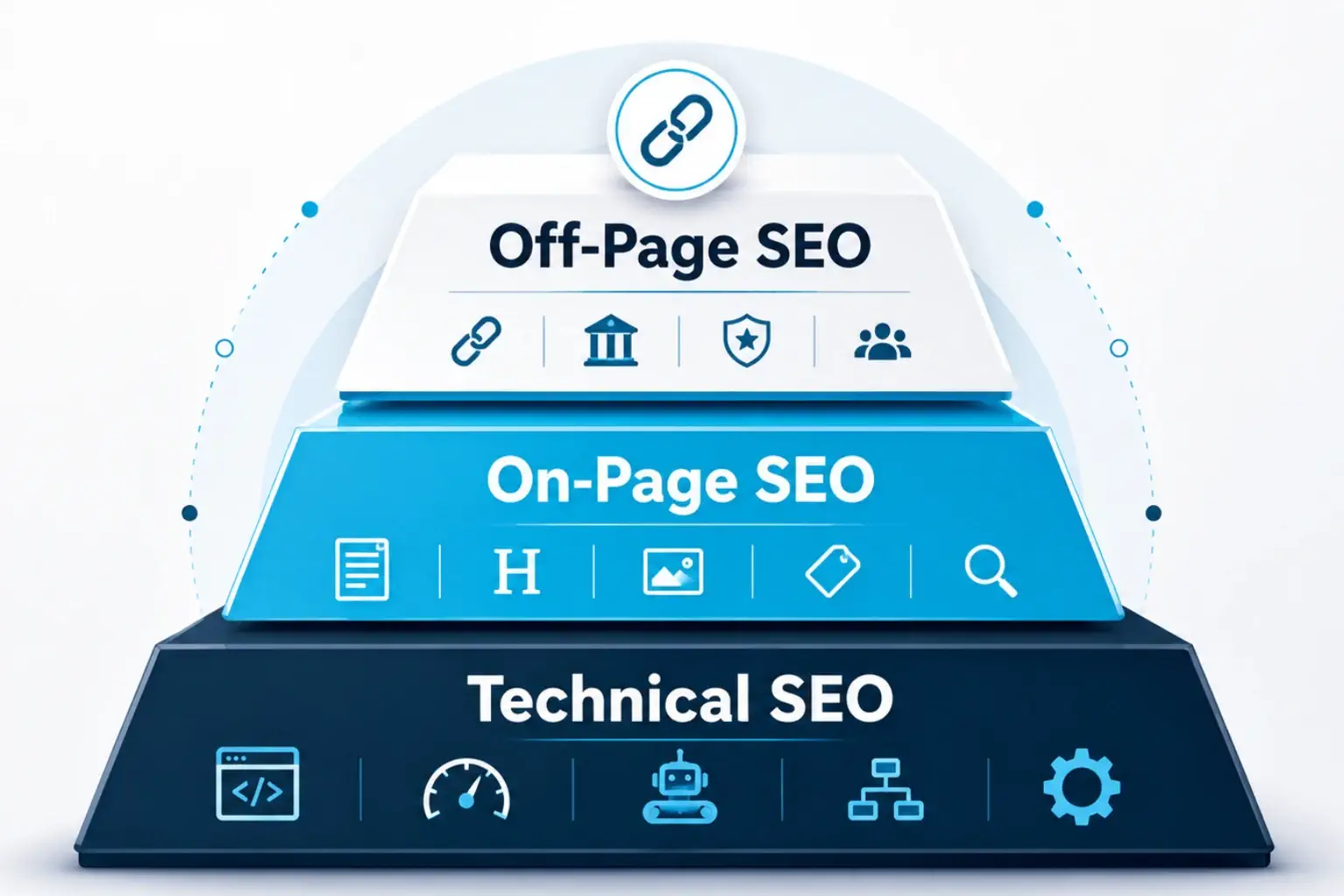
SEO breaks into three categories. On-page SEO is the optimization of content and HTML elements on your website, including page titles, headings, copy, internal links, and image alt text. Off-page SEO is the work that builds your site’s authority from outside, primarily through backlinks, brand mentions, reviews, and local citations. Technical SEO is the backend foundation that lets search engines crawl, index, and render your site properly, covering site speed, mobile usability, structured data, and indexation. All three work together. A website with strong content but a broken technical foundation will not rank. A technically clean site with no content or backlinks will not rank either.
The core factors in each category:
- On-page: title tags, meta descriptions, headings, content quality, keyword targeting, internal linking, image alt text, URL structure
- Off-page: backlinks, brand mentions, online reviews, local citations, Google Business Profile signals
- Technical: crawlability, indexation, site speed, Core Web Vitals, mobile usability, HTTPS, structured data, XML sitemap
That’s the short version. Now the part that actually helps you decide what to do.
What is on-page SEO?
On-page SEO is the work you do directly on your website to help individual pages rank for the right searches. It’s the most visible type of SEO because it’s the part you can see and edit yourself.
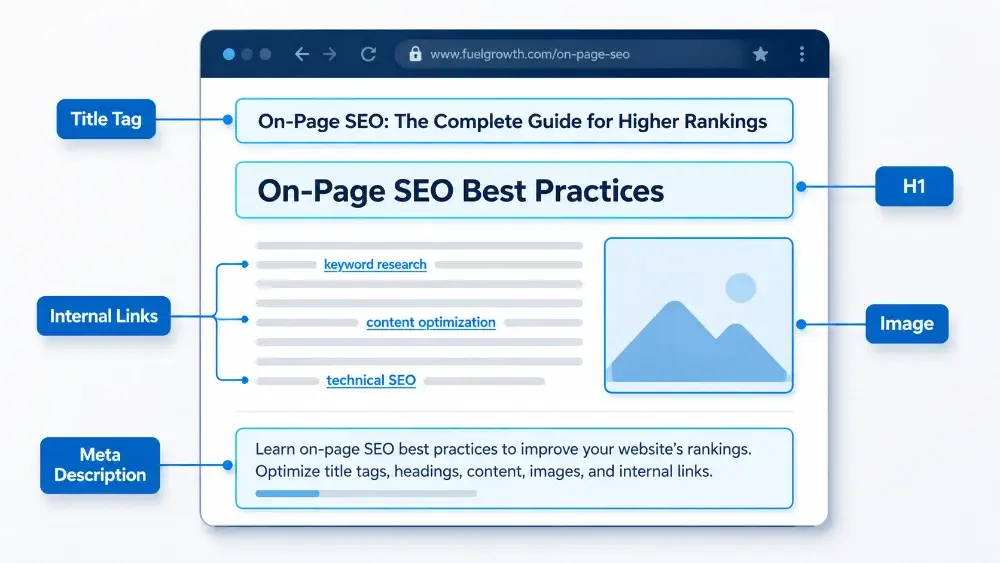
Good on-page SEO does two things at once. It tells search engines what a page is about, and it helps human visitors quickly understand whether the page answers their question. When those two goals line up, rankings tend to follow.
On-page SEO factors that matter
The factors that actually move rankings:
- Title tags. The blue link in the search result. Should include your target keyword and clearly describe the page.
- Meta descriptions. Don’t directly affect rankings, but they affect click-through rate, which does.
- Headings (H1, H2, H3). Give structure to the page and signal topic relevance.
- Content quality and depth. Pages that fully answer the search intent outperform thin or generic pages.
- Keyword targeting based on intent. Targeting the right keyword matters more than stuffing the right number of keywords.
- Internal linking. Helps Google understand your site structure and pushes authority to important pages.
- Image alt text. Improves accessibility and helps images rank in search.
- URL structure. Short, descriptive URLs perform better than long, parameter-heavy ones.
If you want a tactical walkthrough you can apply to your own site, our on-page SEO checklist for small businesses covers each of these in detail.
The thing most small businesses get wrong about on-page SEO is treating it as a one-time setup. It isn’t. Search intent shifts, competitors update their pages, and content needs to be refreshed. On-page SEO is a maintenance habit, not a checklist you complete once.
What is off-page SEO?
Off-page SEO is everything that signals to search engines that other people on the internet trust your website. You don’t control these signals directly. You earn them.
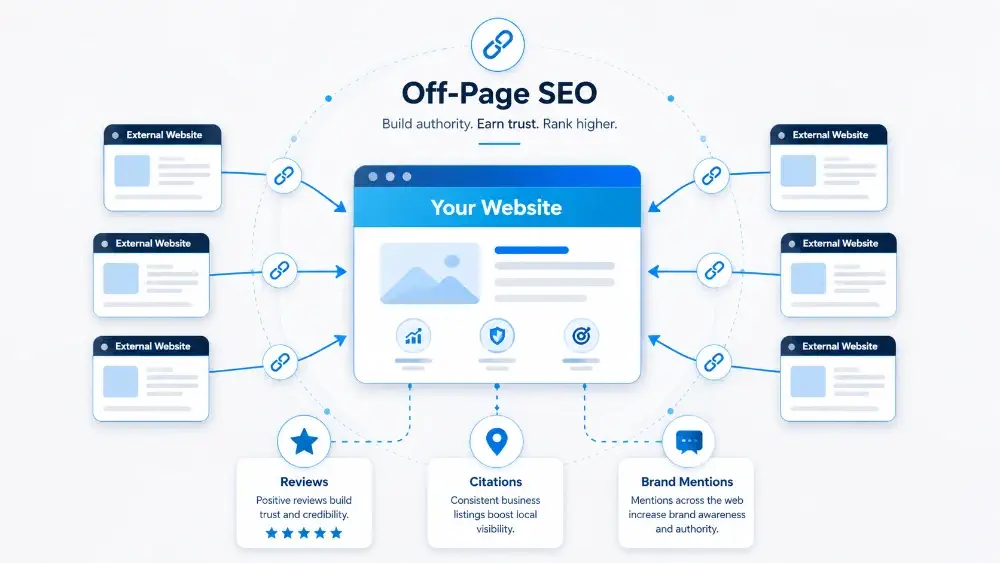
The biggest off-page signal is backlinks. When a credible website links to yours, Google treats it as a vote of confidence. Not all links carry equal weight: a single link from a respected industry publication can move the needle more than fifty links from low-quality directories. This is what domain authority tries to measure, and why it matters when you’re evaluating which links are worth pursuing.
Off-page SEO factors that matter
Beyond raw link counts, the off-page signals that matter most:
- Backlink quality. Relevance and authority of the linking site beats sheer volume every time.
- Brand mentions. Even unlinked mentions of your business name in credible sources carry weight.
- Online reviews. Volume, recency, and sentiment of reviews on Google, industry directories, and third-party sites.
- Local citations. Consistent name, address, and phone number across local directories.
- Google Business Profile signals. Photos, posts, Q&A activity, and review responses.
- Social signals. Indirect, but a strong social presence often correlates with stronger off-page performance.
Off-page SEO takes longer to move than on-page work because you’re depending on other people. That’s also what makes it valuable. It’s harder to fake, harder to replicate, and harder for a competitor to undo.
Where technical SEO fits (and why it’s the foundation)
Technical SEO is the part of search engine optimization most small business owners never see and never get told about. It’s the backend layer that determines whether Google can crawl your site, render your pages, and understand your content at all.
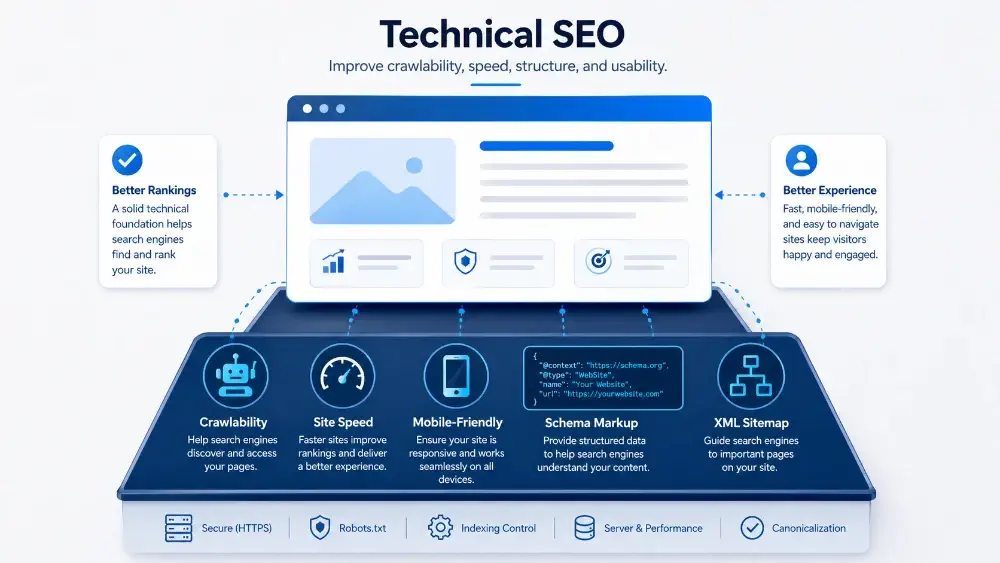
Here’s the part that matters. If your technical SEO is broken, on-page work and off-page work cannot fully translate into rankings. You can write perfect content. You can earn quality backlinks. If Google can’t crawl the page or it loads in eight seconds on mobile, none of it converts into visibility.
That’s why we treat technical SEO as the foundation, not the third item on the list.
Common technical SEO issues small businesses miss
The technical problems we see most often on small business sites:
- Slow page speed. Especially on mobile. Heavy images, bloated themes, and unoptimized scripts.
- Indexation issues. Pages blocked by robots.txt, noindex tags left on by accident, or important pages that never made it into the sitemap.
- Broken internal links and redirect chains. Dead links waste crawl budget and create dead ends for visitors.
- Missing or broken schema markup. Structured data helps Google understand what your pages are (services, products, articles, local business) and unlocks rich results.
- Mobile usability problems. Tap targets too close together, content wider than the screen, intrusive interstitials.
- Duplicate content from URL parameters. Common on e-commerce sites and creates indexing confusion.
- Missing HTTPS or mixed-content warnings. A basic trust signal that’s still missed on older sites.
A proper technical SEO audit surfaces all of this in one pass. If you’d rather work through it yourself first, our technical SEO audit checklist walks through every check we run.
On-page vs off-page vs technical SEO at a glance
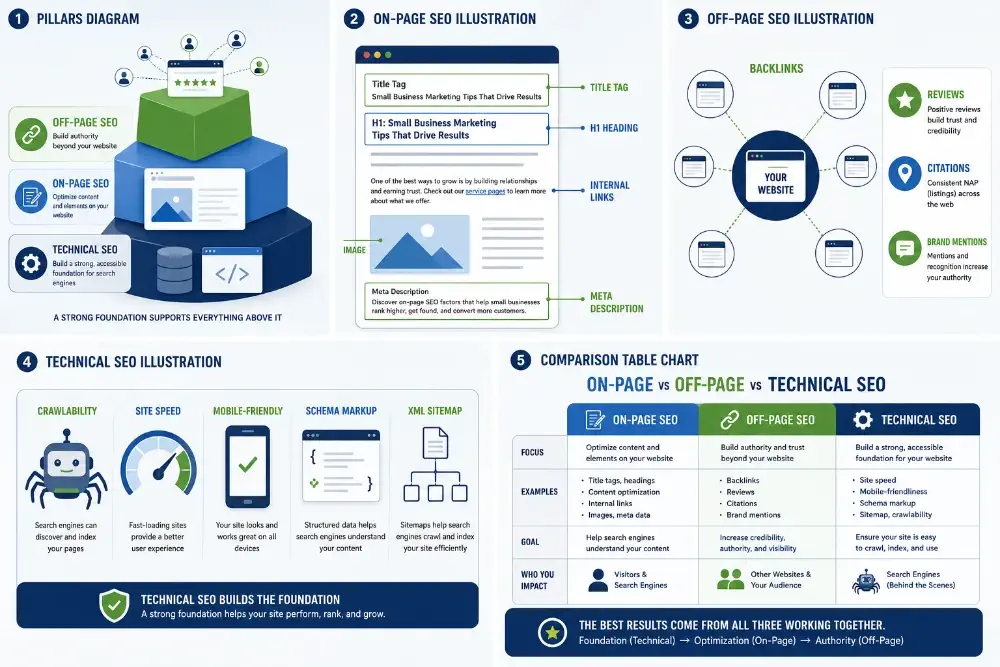
| On-page SEO | Off-page SEO | Technical SEO | |
|---|---|---|---|
| What it is | Optimization of content and HTML on your site | Authority and trust signals from outside your site | Backend foundation that lets Google crawl and index your site |
| Who controls it | You | You influence it, others give it | You (or your developer) |
| Examples | Title tags, content, headings, internal links | Backlinks, reviews, brand mentions, citations | Site speed, indexation, schema, mobile usability |
| How fast it moves rankings | Weeks to a few months | Months, sometimes longer | Often the fastest win when something is broken |
| What happens if you skip it | Pages don’t rank for the right queries | Site lacks authority to compete in hard niches | Other SEO work can’t fully translate into rankings |
Which one should you invest in first?
Here’s the order we recommend, and the reasoning behind it.
Fix technical SEO first. If your site is slow, can’t be crawled properly, or has indexation issues, every dollar you spend on content or backlinks is partially wasted. Technical fixes are often the fastest visible wins in SEO because you’re removing the brakes, not adding horsepower.
Strengthen on-page SEO second. Once Google can crawl your site cleanly, give it pages worth ranking. Target the right keywords, match search intent, structure content properly, and build internal links between related pages. This is where most of your time should go in the first six months.
Build off-page authority third. Once your foundation is solid and your pages are doing their job, invest in backlinks, reviews, citations, and brand presence. Off-page work compounds slowly and is more expensive per unit of effort than on-page work. Doing it before the other two is like pouring water into a leaky bucket.
This order isn’t rigid. If your site is technically clean but has thin content, start with on-page. If your content is strong but you have zero backlinks in a competitive niche, off-page becomes the priority. The point is to diagnose before you spend.
If you’re wondering how long this all takes, our breakdown of how long SEO takes to work lays out realistic timelines for each stage.
Common mistakes small businesses make
A few patterns we see often:
- Buying backlinks before fixing the site. Off-page work on a broken foundation rarely pays off.
- Treating SEO as a one-time project. Search results shift constantly. The work has to be ongoing.
- Chasing rankings instead of leads. Position one for a keyword that doesn’t bring qualified traffic is a vanity win.
- Skipping local SEO when it’s the highest-leverage move. For service businesses, local SEO and Google Business Profile optimization often outperform generic keyword targeting.
- Adding content without an internal linking plan. Orphan pages that nothing links to rarely rank, no matter how well written.
- Hiring an agency that only does one pillar. SEO doesn’t work in isolation. A team that handles only links or only content will hit a ceiling fast.
How to know which type of SEO your business actually needs
You don’t need to guess. Run a quick diagnostic on your own site:
- Open Google Search Console and check the coverage report. If pages you care about aren’t indexed, you have a technical SEO problem.
- Run your homepage and top service page through PageSpeed Insights. If your mobile score is under 50, fix technical SEO first.
- Search your top three target keywords in an incognito browser. Are you ranking on page two or three? That’s usually an on-page issue.
- Check your Google Business Profile. If it’s incomplete, has under ten reviews, or hasn’t been updated in six months, off-page and local work is overdue.
- Look at your backlink profile in a free tool like Ahrefs Webmaster Tools. If you have fewer than twenty referring domains in a competitive industry, off-page is your gap.
Most small businesses we audit need work in two of the three pillars, with one clear priority. The job is to find that priority first, then sequence the rest.
The takeaway
On-page SEO, off-page SEO, and technical SEO aren’t competing strategies. They’re three layers of the same stack. Technical SEO is the foundation that lets the other two work. On-page SEO turns visitors into qualified traffic. Off-page SEO is what gives your site the authority to compete in the long run.
The mistake is treating them as a menu to pick from. The win is sequencing them correctly for your situation.
If you’re not sure which pillar your site needs first, book a free 30-minute strategy call. We’ll look at your site, point out what’s actually holding you back, and give you a clear answer on where to start. No pitch, no contract pressure.
