
Few SEO metrics get thrown around as casually or as carelessly as domain authority. It shows up in pitch decks, agency reports, and LinkedIn posts like it’s the definitive measure of a website’s worth. But most people citing DA don’t fully understand what it measures, where it comes from, or how much weight it actually carries.
Here’s the reality: domain authority is a useful benchmark when you use it correctly. It can help you evaluate competitors, prioritize link building opportunities, and track the general trajectory of your site’s credibility over time. But it’s not a ranking factor. It’s not a goal. And chasing the number without understanding the mechanics behind it leads to wasted effort and bad decisions.
This article breaks down what domain authority actually is, what influences it, how to improve it, and how to think about it strategically, especially as search evolves toward AI-generated results.
What Is Domain Authority?
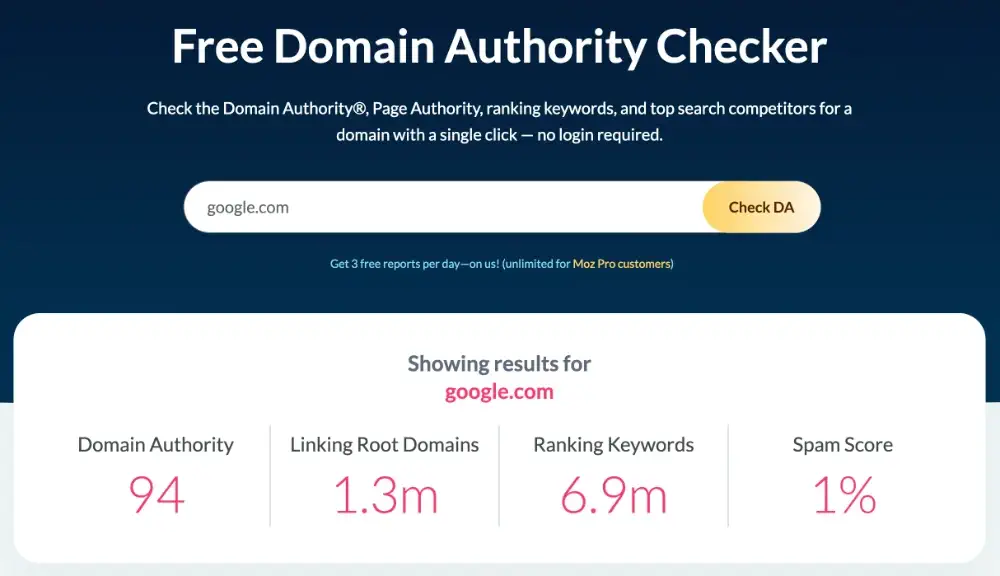
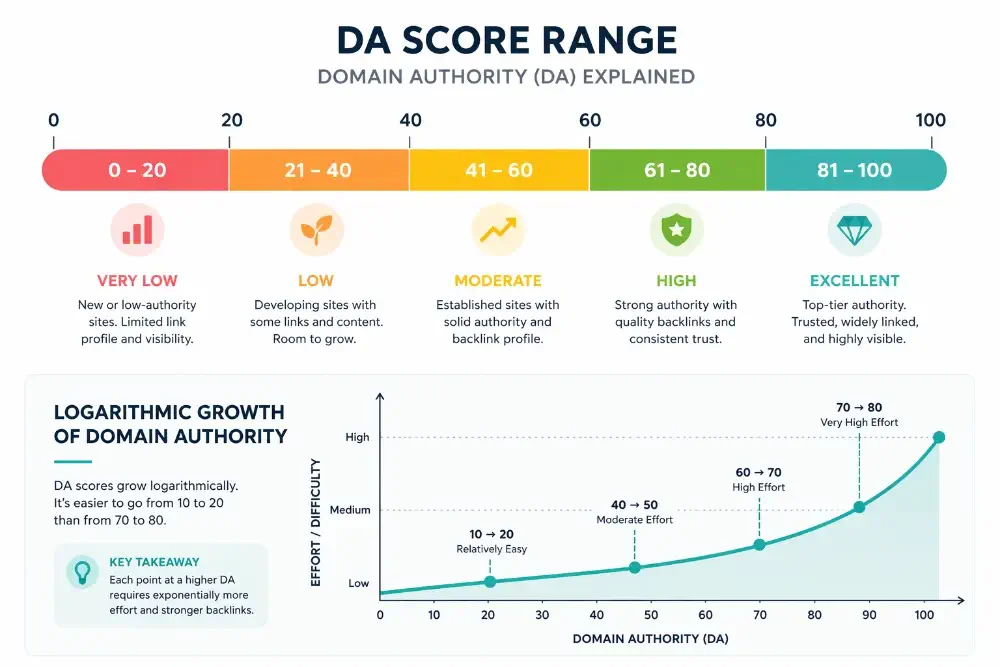
Domain authority (DA) is a predictive metric created by Moz that estimates how likely a website is to rank in search engine results pages (SERPs). It’s scored on a logarithmic scale from 1 to 100. The higher the score, the stronger the site’s predicted ability to rank.
Moz calculates DA using a machine learning model that evaluates over 40 factors, with the strongest signal being the quality and quantity of backlinks pointing to a domain. The model compares a site’s link profile against thousands of real-world SERP results to generate its prediction.
Why the Logarithmic Scale Matters
The logarithmic scale matters here. Moving from a DA of 15 to 25 is significantly easier than moving from 55 to 65. The higher you climb, the more effort each point requires. That’s by design, it reflects the reality that building authority gets harder as competition increases.
Other SEO Platforms Use Different Metrics
Other SEO platforms have introduced their own versions. Ahrefs uses Domain Rating (DR), Semrush offers Authority Score, and Majestic uses Trust Flow. Each uses different data and methodologies, so scores across platforms aren’t interchangeable. A DA of 40 on Moz doesn’t equal a DR of 40 on Ahrefs.
Is Domain Authority a Ranking Factor?
No. Google does not use domain authority or any third-party authority metric in its ranking algorithm. Google’s John Mueller has confirmed multiple times that domain authority is not a Google ranking factor, covered by Search Engine Journal
That said, DA is built on signals that Google does care about. Backlink quality, linking root domains, content relevance, and site structure all feed into how Moz calculates DA, and they also happen to be signals that influence real rankings. So while DA itself doesn’t move the needle in Google’s algorithm, the inputs behind it do.
Think of DA as a proxy, not a cause. A site with a high DA is likely doing a lot of things right like earning links from reputable sources, publishing strong content, maintaining solid technical health. But the DA score itself isn’t what’s driving those rankings. The underlying work is.
What Factors Influence Domain Authority?
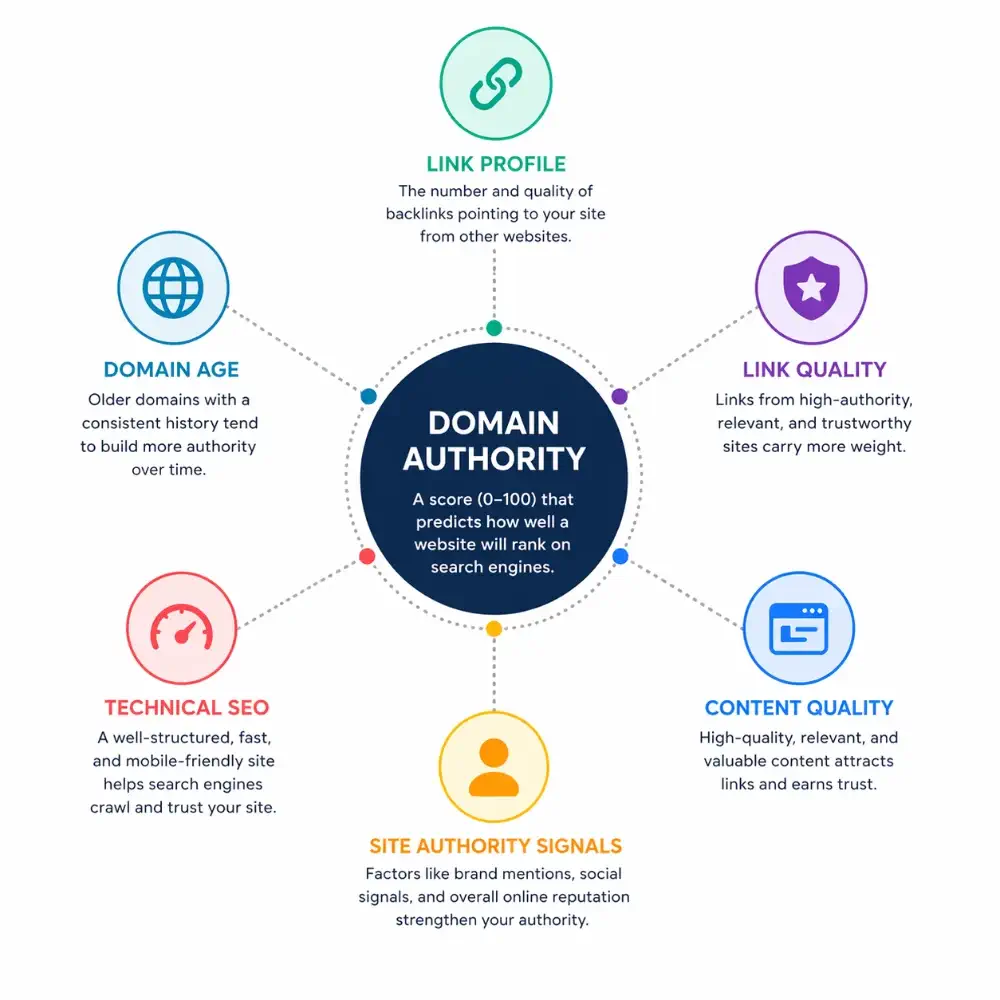
Several factors determine where your site lands on the DA scale. Understanding them helps you focus on the right levers.
Backlink Quality and Diversity
Backlink quality and diversity remain the most influential factors. Links from high-authority, editorially earned sources carry far more weight than hundreds of links from low-quality directories or spammy sites. Moz also evaluates the diversity of linking root domains, 100 backlinks from one site count as a single root domain, which limits their impact compared to links from 50 different trusted sources.
Internal Linking Structure
Internal linking structure affects how authority flows through your site. Well-organized internal links help distribute link equity from your strongest pages to supporting content, improving the overall visibility of your domain.
Content Quality and Relevance
Content quality and relevance play an indirect but powerful role. Strong content attracts organic backlinks, keeps users engaged, and signals topical expertise. Sites that consistently publish useful, well-structured content tend to earn links naturally over time.
Technical Site Health
Technical site health includes factors like broken links, slow load times, poor mobile responsiveness, and crawlability issues, all of which can drag down engagement metrics and make it harder for search engines to access and trust your content. A technically sound site gives your authority signals a clean path to be recognized.
Spam Score
Spam score is another factor Moz evaluates. If your backlink profile contains a high proportion of spammy or low-quality links, it can suppress your DA. Regular link audits help you identify and address these issues before they accumulate.
Domain Age and History
Domain age and history can correlate with higher DA not because age is directly weighted, but because established sites have had more time to earn backlinks, build content, and develop trust signals. A domain that’s been active and well-maintained for ten years will typically have a stronger link profile than a site launched six months ago. But age alone doesn’t move the score.
How to Check Your Domain Authority Score
You can check your DA using several tools. Moz’s free Link Explorer is the most direct option since Moz created the metric. Enter your domain, and you’ll see your DA along with data on linking root domains, inbound links, and spam score.
Ahrefs and Semrush offer their own authority metrics through their respective platforms. These are useful for cross-referencing, but remember that each tool uses different data and algorithms, so expect some variation.
The number itself matters less than how it compares to your direct competitors. A DA of 30 might seem low, but if your top competitors are in the 25–35 range, you’re competitive. Benchmarking against sites in your niche gives you a realistic picture of where you stand and where you need to go.
How to Improve Domain Authority
Improving DA isn’t about gaming a score. It’s about building the signals that the score is designed to reflect. Here are the strategies that actually work.
Earn High-Quality Backlinks
Backlinks are still the primary driver of domain authority. Focus on earning links from reputable, relevant sources rather than accumulating volume from low-value sites.
Guest posting on respected industry publications, contributing expert commentary to journalists, creating original research or data that others want to reference, and building relationships with complementary businesses are all effective approaches. Broken link building, finding dead links on authoritative sites and offering your content as a replacement is another underused tactic.
The key word here is earn. Buying links, participating in link schemes, or relying on private blog networks might inflate your DA temporarily, but these tactics carry real risk and rarely produce lasting results.
Create Content Worth Linking To
No one links to thin, generic content. If you want backlinks, you need to publish material that solves problems, presents original insights, or provides something readers can’t easily find elsewhere.
In-depth guides, data-driven research, practical frameworks, and well-constructed how-to content tend to attract the most organic links. Think about what would make someone in your industry say, “I need to share this.” That’s the bar.
Updating and improving existing content also helps. Refreshing outdated posts with current data, better structure, and deeper insights can revive their link-earning potential and improve their rankings. A strong on-page SEO foundation ensures that your content is optimized to perform once it’s published.
Build a Strong Internal Linking Structure
Internal links are often overlooked, but they play a real role in distributing authority across your site. When your highest-authority pages link to supporting content, they pass link equity downstream, strengthening those pages’ ability to rank.
Use descriptive anchor text. Link contextually and don’t force links where they don’t fit. And audit your internal linking regularly to make sure new content is connected to your existing site architecture.
Clean Up Toxic Backlinks
A cluttered backlink profile can drag your DA down. If your site has accumulated links from spammy, irrelevant, or low-quality sources, it’s worth auditing and addressing them.
Use Moz, Ahrefs, or Google Search Console to identify problematic links. You can request removal directly from the linking site or, as a last resort, use Google’s disavow tool to tell search engines to ignore those links.
Improve Your Technical SEO
Technical issues create friction for users and for search engines. Slow page load times, mobile usability problems, broken internal links, and missing or poorly structured metadata all undermine the signals that contribute to authority.
Fix crawl errors. Compress images. Ensure your site is responsive across devices. Submit clean, updated sitemaps. These aren’t flashy tactics, but they create the foundation that everything else builds on.
Benchmark Against Competitors
DA is a comparative metric, so use it comparatively. Identify your top 5–10 organic competitors, check their DA scores, and analyze their backlink profiles. Look at where they’re earning links that you’re not, what content is driving their authority, and where you can realistically close the gap.
This benchmarking exercise isn’t about copying competitors. It’s about understanding the competitive landscape and finding specific opportunities to strengthen your own position.
Common Mistakes When Chasing Domain Authority
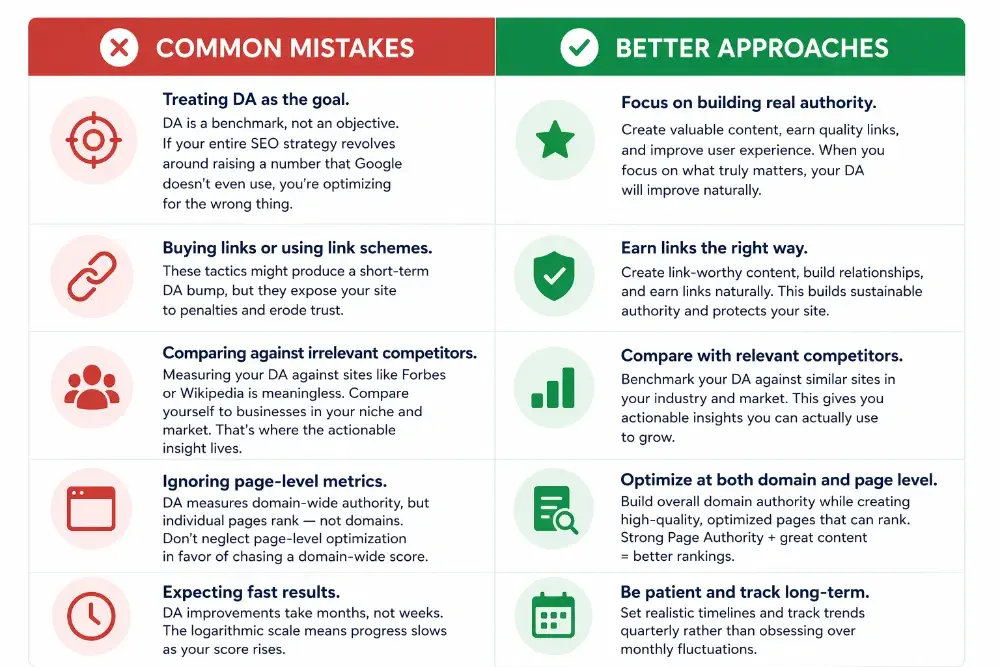
Treating DA as the Goal
DA is a benchmark, not an objective. If your entire SEO strategy revolves around raising a number that Google doesn’t even use, you’re optimizing for the wrong thing. Focus on the work that builds real authority and the score will follow.
Buying Links or Using Link Schemes
These tactics might produce a short-term DA bump, but they expose your site to penalties and erode trust. Moz’s algorithm has also become better at detecting manipulated link profiles, so the gains rarely last.
Comparing Against Irrelevant Competitors
Measuring your DA against sites like Forbes or Wikipedia is meaningless. Compare yourself to businesses in your niche and market. That’s where the actionable insight lives.
Ignoring Page-Level Metrics
DA measures domain-wide authority, but individual pages rank not domains. A page with strong Page Authority, relevant content, and solid on-page SEO can outrank pages from higher-DA sites. Don’t neglect page-level optimization in favor of chasing a domain-wide score.
Expecting Fast Results
DA improvements take months, not weeks. The logarithmic scale means progress slows as your score rises. Set realistic timelines and track trends quarterly rather than obsessing over monthly fluctuations.
Domain Authority in the Age of AI Overviews
As Google continues rolling out AI Overviews and AI-generated answers become a more prominent part of search, the concept of authority takes on new significance.
AI Overviews tend to pull from sources that demonstrate clear expertise, well-structured content, and established credibility which are the same signals that contribute to a strong DA. While Google hasn’t confirmed a direct link between DA like metrics and AI Overview inclusion, the pattern is consistent: sites with strong authority signals are more likely to be cited in AI-generated responses.
This means the strategies that improve your DA such as earning quality backlinks, publishing authoritative content, and maintaining technical health also position your site for visibility in AI-driven search results. Building genuine authority isn’t just about ranking in traditional blue links anymore. It’s about being the source that AI systems trust enough to reference.
Answer engine optimization (AEO) complements this approach. Structuring your content with clear definitions, direct answers, and well-organized headings makes it easier for both traditional search algorithms and AI systems to extract and cite your information. If you’re already writing clear, well-structured, authoritative content, you’re already doing most of the work.
How to Think About Domain Authority Strategically
The most productive way to use DA is as a diagnostic tool, not a destination. It tells you roughly where your site stands relative to competitors, gives you a signal of whether your SEO efforts are trending in the right direction, and helps you evaluate whether a particular keyword or SERP is within competitive reach.
But the score itself is a symptom, not a strategy. A rising DA reflects strong backlinks, quality content, and a healthy site. A stagnant or declining DA suggests something needs attention like your link profile, your content output, or your technical foundation.
If you focus on creating genuinely useful content, earning links from credible sources, keeping your site technically sound, and building topical authority in your niche, DA will take care of itself. The sites that win in search and increasingly in AI-generated results are the ones that prioritize real value over metric chasing.
That’s the strategic takeaway: don’t chase domain authority. Build the authority that domain authority tries to measure.
Frequently Asked Questions
What Is a Good Domain Authority Score?
It depends on your industry and competition. There’s no universal benchmark. A DA of 30 might be strong in a niche local market, while a DA of 60 might be average in a competitive national space. The most useful comparison is always against your direct competitors, not against an arbitrary number.
How Long Does It Take to Improve Domain Authority?
Meaningful improvements typically take several months of consistent effort. The logarithmic scale means early gains come faster, but progress slows as your score increases. Focus on quarterly trends rather than week-to-week changes, and expect that sustained content creation and link building are required to move the needle.
Does Domain Authority Directly Affect Google Rankings?
No. Domain authority is a third-party metric developed by Moz. Google does not use it in its ranking algorithm. However, the factors that influence DA, particularly backlink quality, content relevance, and technical health are factors that Google does consider. Improving those signals benefits both your DA and your actual rankings.
How Often Does Moz Update Domain Authority?
Moz typically updates DA scores approximately once per month. Because of this refresh cycle, your score may fluctuate even if you haven’t made significant changes. Minor dips and rises are normal and don’t necessarily indicate a problem. Track the long-term trend rather than reacting to individual updates.
Can Domain Authority Be Manipulated?
Yes, and it’s a known issue. Some services sell inflated DA through artificial link building, private blog networks, or other schemes. However, these manipulated scores don’t translate to real ranking improvements and can lead to penalties. Moz has improved its algorithm to detect manipulation, but it’s still possible to temporarily inflate scores. Treat suspiciously high DA on unfamiliar sites with skepticism, especially when evaluating backlink opportunities.
Does Domain Authority Affect Visibility in AI Overviews?
There’s no confirmed direct relationship, but the correlation is strong. AI Overviews tend to cite sources that demonstrate clear expertise, credibility, and well-structured content which is the same qualities that contribute to higher DA. Building genuine authority through quality content and earned backlinks positions your site favorably for both traditional rankings and AI-generated search results.
