
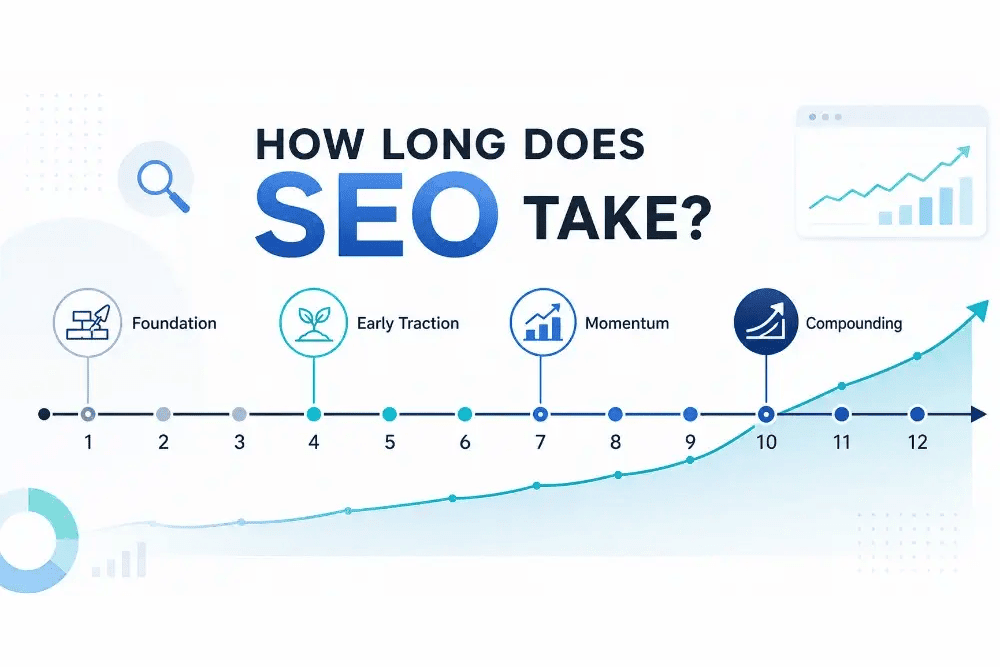
If you’ve ever asked an SEO agency how long does SEO take and gotten a confident “30 days” or “guaranteed page one in 90 days,” you’ve already met the wrong agency. The honest answer is less satisfying and more useful: most websites see meaningful SEO results in three to six months, with stronger compounding gains between six and twelve months. Anything faster than that is usually either a low-competition keyword winning by default, a paid placement masquerading as organic, or a promise that won’t survive contact with reality.
This guide walks through what a realistic SEO timeline actually looks like, what changes it, and how to tell whether the work is paying off long before rankings move. No hype, no hedging.
How long does SEO take to work? The honest answer
SEO typically takes three to six months to produce measurable results, and six to twelve months in competitive industries. Some early signals appear within weeks. Sustainable traffic and lead growth take longer.
The exact timeline depends on:
- Domain age and history. Older sites with clean histories rank faster than brand-new domains.
- Competition in your niche. Local plumbing in a mid-sized city moves faster than national finance keywords.
- Existing technical health. A site with crawl errors, slow load times, or indexation issues has to fix the foundation before rankings can climb.
- Content quality and cadence. Consistent, well-targeted content compounds. Sporadic content stalls.
- Backlink profile. Sites with existing authority rank new pages faster.
- How fast changes get implemented. SEO recommendations sitting in a developer queue for two months delay every downstream result.
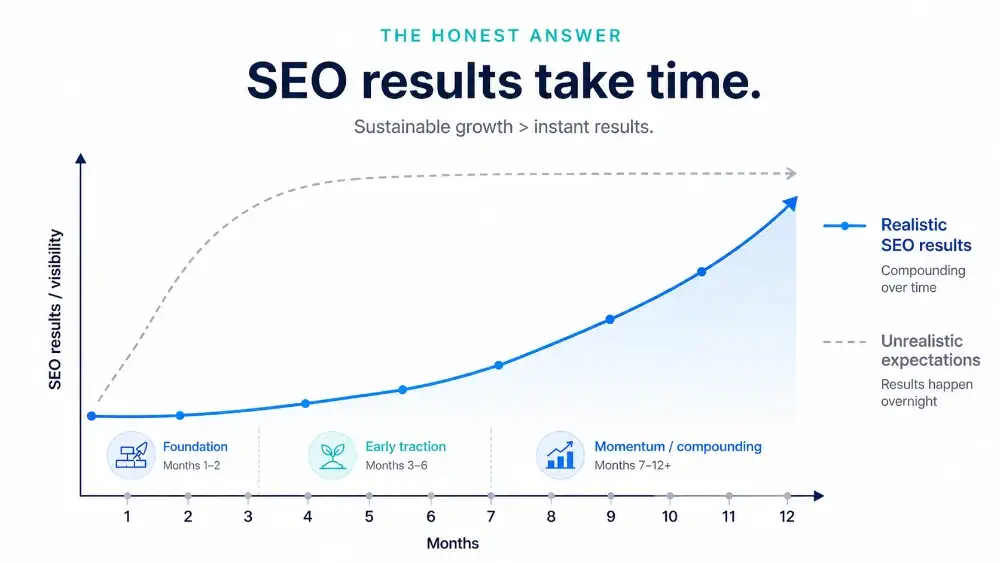
That’s the framework. The rest of this guide expands on it.
What “results” actually means (and why most agencies define it wrong)
A lot of timeline confusion comes from the word results.
If “results” means rankings on a low-competition long-tail keyword, you can see those in two to four weeks. If “results” means qualified leads from organic search that show up in your CRM with revenue attached, that takes longer. The agencies that promise fast results usually mean the first thing. The clients paying them are usually expecting the second.
Here’s a more useful way to define it:
- Indexing and crawl improvements: 1–2 weeks
- Technical fixes showing impact: 2–4 weeks
- New content gaining initial traction: 6–12 weeks
- Keyword ranking improvements on competitive terms: 3–6 months
- Significant organic traffic increases: 6–12 months
- Revenue growth from organic: 6–18 months
If your agency reports on rankings and impressions but never on form fills, calls, or qualified leads, you’re being measured on the easy stuff. Real SEO performance ties back to business outcomes, which is exactly why a transparent SEO pricing model paired with conversion-tied reporting matters. The number you actually care about is leads, not impressions.
A realistic SEO timeline, month by month
Every site is different. The numbers below assume an established business website with no major penalties, a competent SEO partner, and reasonable execution speed.
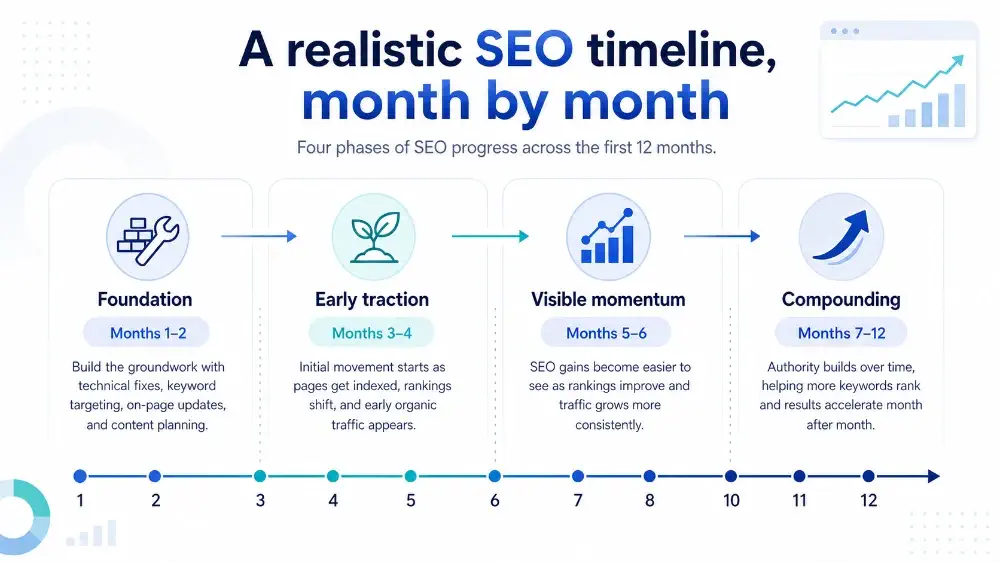
Months 1–2: Foundation work
Most of the early work is invisible to the outside observer and unsexy from the inside. This is when the technical SEO audit happens, keyword research is mapped to real buyer intent, the content strategy is built, on-page issues are flagged, and analytics and conversion tracking are properly set up.
You won’t see ranking changes yet. You will see cleaner data, faster pages, and a clear plan. If the agency you’ve hired is producing a stack of strategy documents in month one and you’re tempted to ask “where are the results,” resist that instinct. Foundation work in months one and two is what makes months three through six possible.
Months 3–4: Early traction
This is when the work starts to show up in the data. Optimized pages begin moving in rankings. New content starts getting indexed and earning impressions. Long-tail keywords start ranking first because they’re easier to win.
Expect to see:
- Increases in impressions in Google Search Console
- Movement on lower-competition keywords (sometimes into the top 20–30)
- Better click-through rates on optimized title tags and meta descriptions
- Early traffic from new content, especially if the on-page SEO is tight
This is also when Google often shifts pages up and down to test how they perform. A page might appear at position 12, drop to 28, and bounce back to 8. That’s normal — Google is calibrating.
Months 5–6: Visible momentum
This is the stretch where most clients stop asking “is SEO actually working?”
Rankings stabilize on priority keywords. Organic traffic starts climbing in a recognizable curve, not a spike. The first SEO-driven leads or sales usually show up here. Content published in months one and two is now mature enough to rank for competitive terms, not just easy ones.
If you set realistic expectations on day one and the work was executed well, this is the inflection point. If you set unrealistic expectations and the work was thin, this is when the relationship usually ends.
Months 7–12: Compounding returns
Authority compounds. Content clusters reinforce each other. Internal linking starts pulling weight. The site begins ranking for terms that were unreachable in month three.
In this stretch, well-executed SEO often outperforms paid ads on cost per acquisition. The traffic is recurring, the leads are warmer, and you’re not paying per click. This is the part of the curve that justifies the patience required in months one through four.
The catch: this only happens if you don’t break momentum. Switching agencies, pausing content, or pivoting your strategy mid-stream resets a chunk of the work.
What changes the SEO timeline (faster or slower)
The timeline above is a midpoint. Your actual experience can shift in either direction depending on a few specific factors.
Things that speed up the timeline:
- Existing domain authority and a clean backlink profile
- A technically healthy site with no crawl, indexation, or speed issues
- Targeting realistic, lower-competition keywords first
- Fast implementation cycles (changes go live in days, not months)
- Consistent content publishing cadence
- A clear, tight focus on a defined niche or geography
Things that slow it down:
- A new domain with no history
- A penalized or recovering site
- Slow developer queues holding up technical fixes
- Unrealistic keyword targets from day one (e.g., “rank for ‘business loans’ in month three”)
- Stop-start content production
- Frequent strategy pivots — every reset costs months
Most underperforming SEO campaigns aren’t underperforming because Google changed the rules. They’re underperforming because something on this list went unaddressed.
SEO timelines by business type
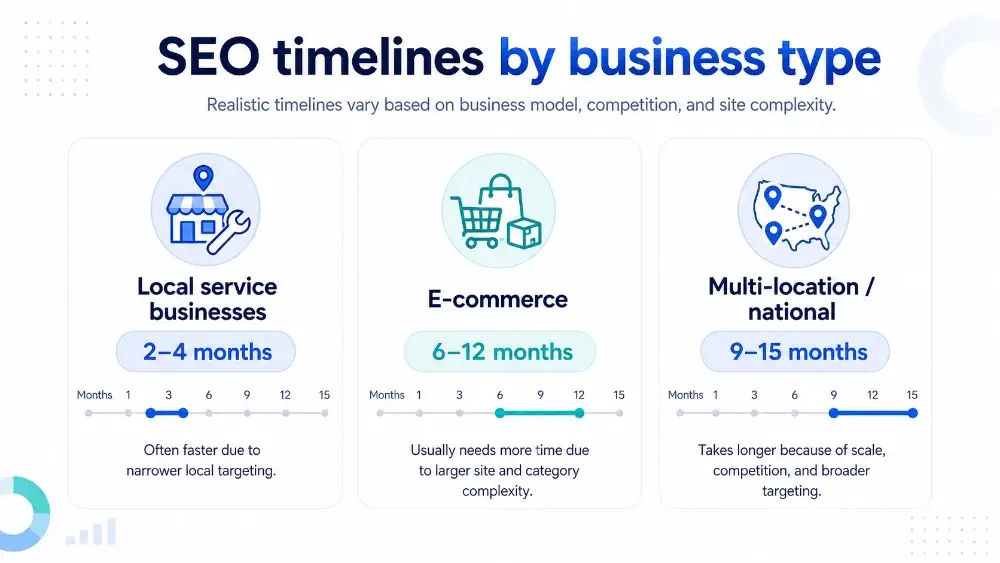
Generic timelines are useful as a baseline, but the buyer reading this article is usually one of three types of business — and the timeline shifts meaningfully across them.
Local service businesses
Local SEO moves the fastest. Service businesses with a defined geographic footprint can often see meaningful traction in two to four months. The reason is simple: you’re competing against a smaller pool of locally relevant sites, and Google Business Profile, citations, and “near me” optimization can move quickly when done right. A well-optimized Google Business Profile alone can produce calls within weeks.
E-commerce and Shopify brands
E-commerce sites typically need six to twelve months for substantial organic growth. Product and category pages are competing against marketplaces with massive authority (Amazon, eBay, Etsy), and product page SEO depends on technical health, structured data, and topical authority that take time to build. Long-tail product queries rank first; competitive head terms come later.
Multi-location and national sites
Multi-location and nationally-targeted sites face the longest timelines — often nine to fifteen months for meaningful results. The wins are bigger when they come, but the foundational work is heavier: location pages, hreflang for international, internal linking architecture, and content depth across multiple verticals. Patience here pays off, but only if the strategy is genuinely tailored to multi-location dynamics.
Why SEO takes longer than PPC (and why both work better together)
PPC produces traffic in 24 hours. SEO produces traffic in 24 weeks. People often interpret that as PPC being “better,” which is the wrong frame.
PPC and SEO solve different problems on different timelines. PPC is a treadmill — you stop paying, the traffic stops. SEO is a flywheel — the traffic compounds and the cost per lead drops over time. The smartest setup for most growing businesses is to run paid ads for immediate lead flow while SEO builds underneath, so by month six or nine, the dependency on paid spend starts dropping.
This is why most clients running SEO services also run PPC. Not because either channel is weak, but because they cover different parts of the timeline. Bundling them isn’t a marketing pitch — it’s basic risk management for any business that can’t afford to wait six months for traffic.
Red flags: when an agency promises a faster timeline than this
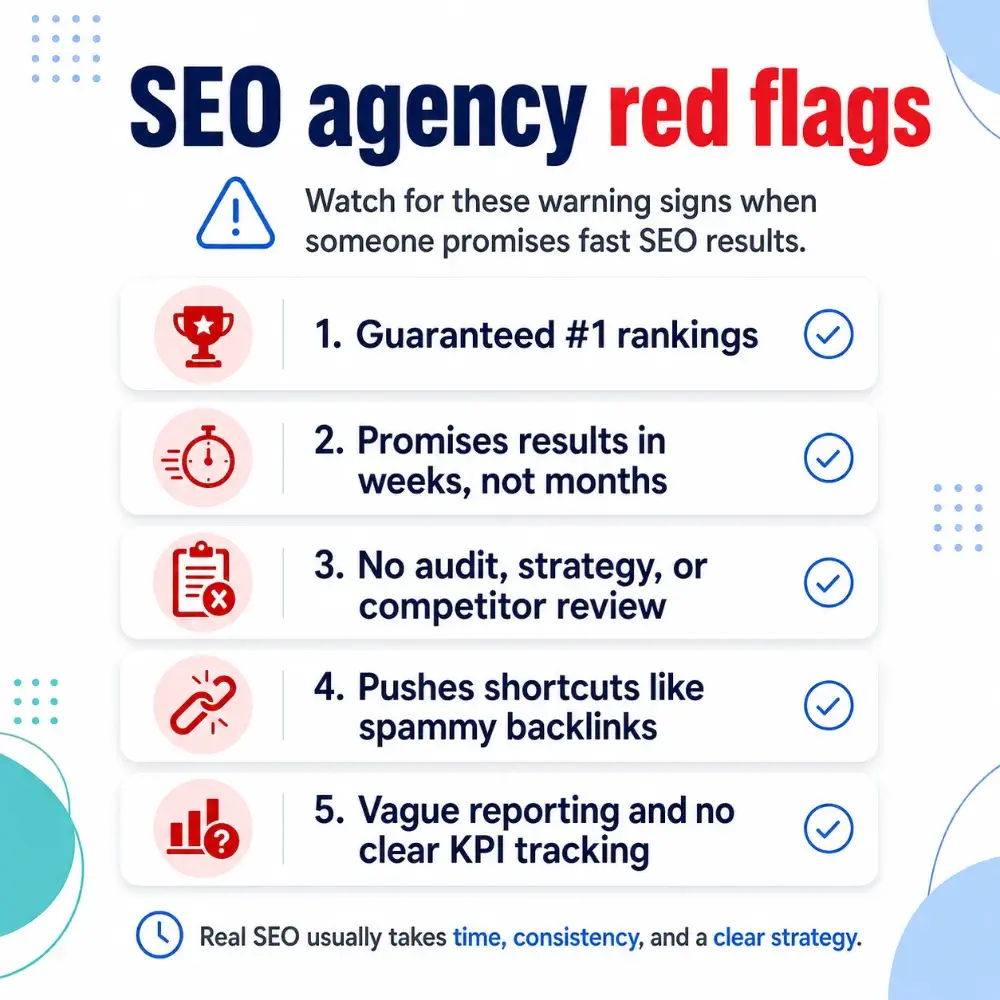
If anyone tells you they can guarantee page-one rankings in 30 days, the right response is to leave the meeting. Here are the specific phrases worth treating as warnings:
- “Guaranteed rankings in 30 days.”
- “We have a special relationship with Google.”
- “We can rank you for [highly competitive keyword] in three months.”
- “You’ll see results immediately.”
- “We don’t need to do a technical audit first.”
The honest version: ranking movement on competitive keywords takes three to six months minimum. Anyone promising less is either ranking you for keywords nobody searches, using tactics that will get you penalized, or hoping you cancel before you notice the lack of results.
The agencies worth working with quote ranges, not guarantees. They explain what changes the timeline. They show you the work in months one and two even though rankings haven’t moved yet. And they’d rather lose your business at the discovery call than lock you into a 12-month contract that disappoints you.
How to know SEO is working before rankings move
The most useful question isn’t “when will I rank?” It’s “how do I tell whether the work is on track in month two, before rankings have had time to move?”
A few leading indicators that genuinely matter:
- Crawl and indexation health. New pages getting indexed within days, not weeks.
- Impressions in Google Search Console. Even before clicks, a rising impression count means Google is testing your pages.
- Movement on long-tail keywords. These rank first. If nothing is moving on long-tails by month three, something is wrong.
- Improvements in Core Web Vitals and page speed. These are direct ranking signals you can verify yourself.
- Backlinks earned. Quality, not quantity. A few relevant links beat dozens of spammy ones.
- Conversion tracking actually working. If the agency hasn’t set up GA4 and Google Search Console properly by month two, that’s a problem.
If those leading indicators are moving in the right direction, the lagging indicators — rankings, traffic, leads — usually follow on schedule. If they’re not moving, the timeline is at risk regardless of what the monthly report says. For a deeper checklist of what good early-stage execution looks like, the on-page SEO checklist for small businesses and the technical SEO audit checklist are useful reference points.
The takeaway
SEO takes three to six months to produce measurable results, and six to twelve months for compounding returns. The timeline isn’t a marketing problem — it’s a structural feature of how search engines evaluate trust. The right question isn’t how do I make SEO faster, it’s how do I make sure the work being done in months one and two is actually setting up the results in months four through twelve.
The fastest-moving SEO campaigns share three traits: realistic expectations from day one, foundational work that doesn’t get skipped, and a partner who reports on leads instead of impressions.
If you want a clear-eyed read on where your site stands today, what your timeline realistically looks like, and what would actually move the needle, book a free 30-minute strategy call. No pitch, no contract, no pressure — just an honest conversation about your timeline.
