
Quick answer: how local SEO works in Vancouver
Local SEO is how a Vancouver business gets found by people searching nearby — in Google’s map pack and local results. Google ranks local results on three signals: relevance (how well you match the search), distance (how close you are to the searcher), and prominence (how established your business looks). You cannot change distance, so the work concentrates on the other two.
If you would rather have this done for you, see our local SEO services in Vancouver.
If you only do three things, do these:
- Claim and fully complete your Google Business Profile — correct primary category, real service areas, accurate hours, current photos. It is the highest-leverage asset in local search.
- Make your NAP consistent everywhere — identical business name, address, and phone number on your site and across every major directory. Inconsistency actively suppresses rankings.
- Build a steady flow of genuine reviews and reply to all of them. Recency and consistency matter more than raw volume.
Realistic timeline: most Vancouver businesses see meaningful ranking movement within three to six months, with larger organic gains landing between six and twelve months. Local SEO usually moves faster than national SEO because the competitive set is smaller.
A customer two blocks away pulls out their phone, types “plumber near me,” and hires whoever shows up first. If that business isn’t you, you didn’t lose on price or service. You lost on visibility. Closing that gap is exactly what local SEO Vancouver businesses need to do, and most of it comes down to a handful of signals you can actually control.
The good news is that you are not competing against the whole internet. You are competing against the other businesses in your service area, and most of them are doing the basics badly. That leaves a lot of room to win.
This guide walks through how local search works in Vancouver, what moves the needle, and where to start if your time is limited.
What local SEO actually means for a Vancouver business
Local SEO is the practice of optimizing your online presence so your business shows up when nearby customers search for what you offer. For a Vancouver business, that means appearing in three places: the map pack at the top of local results, Google Maps itself, and the organic listings underneath.
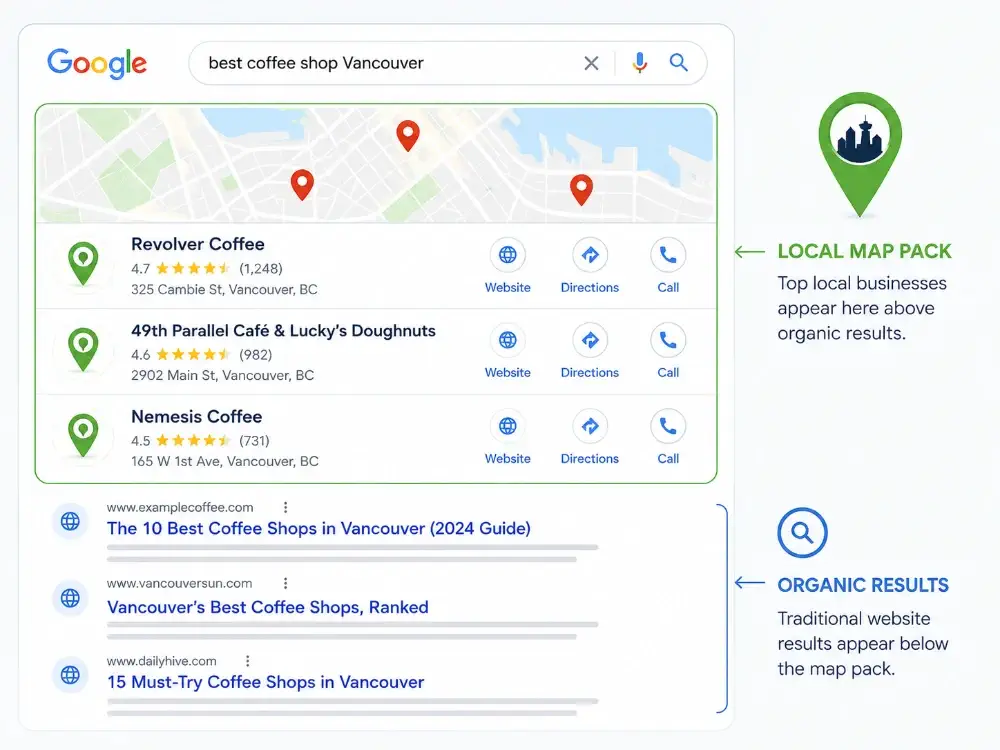
It is different from regular SEO in one important way. Standard SEO is mostly about your website. Local SEO is about your website plus your Google Business Profile, your reviews, and how consistently your business information appears across the web. A national blog can rank from anywhere. A local business has to prove it is genuinely relevant to a specific place, whether that place is Kitsilano, Mount Pleasant, or the North Shore.
So when someone searches “coffee shop Gastown” or “accountant near me” from a phone in Yaletown, Google is not just asking who has the best website. It is asking who is relevant, who is close, and who looks trustworthy. Get those three signals right and you start showing up for the searches that actually bring in customers.
How Google decides who shows up in local search
Google ranks local results using three core factors, and understanding them tells you where to spend your effort.
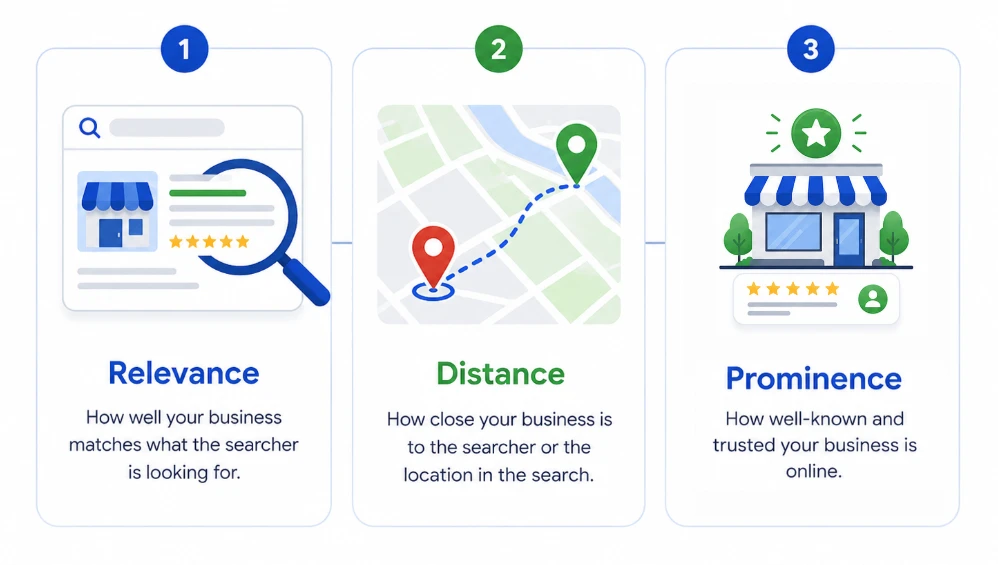
- Relevance is how well your business matches what someone searched for. A complete Google Business Profile with the right categories and accurate services helps Google understand exactly what you do.
- Distance is how close your business is to the searcher, or to the location named in the search. You can’t move your shop, but you can make sure Google knows precisely where you are and which areas you serve.
- Prominence is how well known and trusted your business looks online. Reviews, citations, links from local sites, and overall reputation all feed into this.
Distance is the one factor you can’t directly change, which is why relevance and prominence are where smart businesses focus. You strengthen relevance by being thorough and accurate. You build prominence over time through reviews, consistent listings, and local visibility. Both are within reach for a small business willing to do the work.
Your Google Business Profile is the foundation
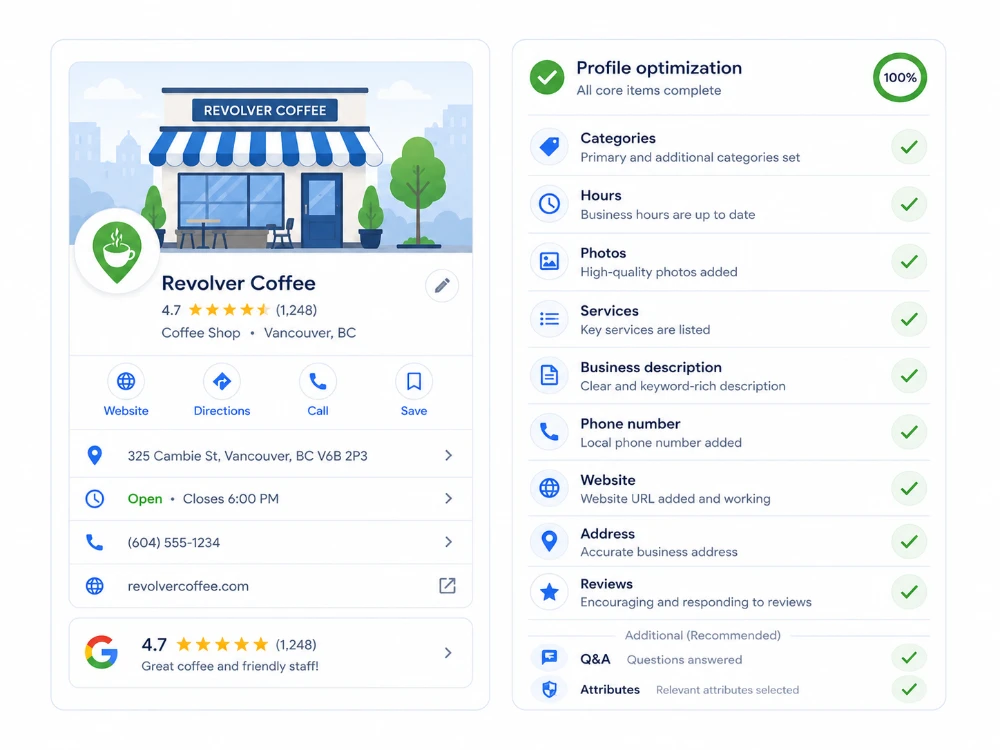
If you do one thing after reading this guide, make it your Google Business Profile. It is the single biggest lever in local search, and it is free. Your profile is what powers your spot in the map pack, and most competitors treat it as a set-it-and-forget-it task. That is your opening.
What to fill in and why
Google rewards complete, accurate profiles. Every field you leave blank is a signal you have given up to a more thorough competitor. Fill in all of it:
- Name, address, and phone number that exactly match what appears on your website.
- Hours that stay current, including holidays and seasonal changes.
- Primary category that describes your core business, plus secondary categories for other services.
- Services and a clear description written for customers, using the words they actually search for.
The category choice matters more than people expect. A “patio furniture store” and a “furniture store” can rank for very different searches, so pick the category that matches how your best customers describe what you sell.
Categories, photos, and posts
Once the basics are in place, treat the profile as an active asset rather than a static listing. Three habits make a difference:
- Add real photos regularly. Profiles with current, genuine photos earn more clicks, more calls, and more direction requests than bare listings.
- Post updates. Use Google posts to share offers, news, or seasonal updates. Consistent activity signals to Google that the business is open and engaged.
- Answer questions and reviews. Responding shows customers and Google that you are present and paying attention.
None of this is complicated. It just requires showing up consistently, which is exactly what most local competitors fail to do.
Get your reviews working for you
Reviews are one of the strongest prominence signals in local search, and their weight has been climbing. They influence rankings, and they influence whether someone clicks you or the business listed right below you.
The goal is a steady, natural flow of honest reviews, not a sudden flood. The most reliable way to get them is simply to ask satisfied customers at the right moment, when the job is done and they are happy. Make it easy by sending a direct link to your review page.
There is a subtle ranking benefit too. When customers naturally mention what you do and where, like “best brunch in Commercial Drive” or “reliable electrician in Burnaby,” those phrases reinforce your relevance for those exact searches. You can’t script reviews, but you can prompt customers in a way that encourages them to describe their experience in their own words.
Just as important is responding to every review, positive or negative. A calm, professional reply to a critical review often does more for your reputation than the review itself does damage.
NAP consistency and local citations
NAP stands for name, address, and phone number. Keeping it identical everywhere your business appears online sounds tedious, and it is, but inconsistency quietly drags down your local rankings.
The problem is simple. If your address reads “Suite 200” on your website, “#200” on Yelp, and “Unit 200” on an old directory, Google has to guess whether these listings represent one business or several. That uncertainty erodes trust in your listing. Clean, matching information across the web removes the doubt.
Local citations are the listings themselves: business directories, industry sites, local chambers, and review platforms that mention your NAP. You don’t need hundreds. You need accurate ones on the platforms that matter for your industry and your city. Start with the major directories, then add a few well-regarded local and niche sites relevant to your field.
The takeaway here is boring but true. Consistency wins. Audit your existing listings, fix the mismatches, and keep new ones accurate from the start.
On-page local SEO for your website
Your Google Business Profile gets you into the map pack. Your website helps you rank in the organic results below it and supports the whole effort. The two work together.
On-page local SEO means giving Google clear location signals on your actual site. The fundamentals are straightforward: include your city and service areas in your title tags, headings, and page content where it reads naturally, embed a Google map on your contact page, and put your NAP in the footer so it appears site-wide. If you want a fuller walkthrough of the page-level fundamentals, our on-page SEO checklist for small businesses covers the rest.
The mistake to avoid is keyword stuffing. Dropping “Vancouver” into every sentence or running a find-and-replace with neighbourhood names reads as spam to both customers and Google. Write for the person first, then make sure the location context is clearly present.
Location and neighbourhood pages done right
If you serve multiple areas, location pages can help, but only when each one earns its place. A page that swaps the city name and changes nothing else adds no value and can hurt you.
A page worth publishing has genuinely unique content for that area: the specific services you provide there, local landmarks or considerations, real examples, and details that only apply to that neighbourhood. A roofing company might write meaningfully different pages for the North Shore versus downtown because the housing stock and weather exposure differ. If you can’t write something distinct and useful for an area, you probably don’t need a separate page for it yet.
Earning local relevance and links in Vancouver
Prominence is partly built through links from other websites, and for local businesses, local links carry extra weight. A link from a Vancouver organization or publication tells Google you are an established part of this community, not just another listing.
These links are more reachable than they sound. Practical sources include:
- Local sponsorships of teams, events, or community groups that list sponsors on their sites.
- Local partnerships with complementary businesses that can link to you, and you to them.
- Local press and roundups, like a “best of” feature in a neighbourhood publication.
- Industry and community memberships such as a chamber of commerce or trade association.
You don’t need a large volume of these. A handful of relevant, genuinely local links does more for a small business than a pile of generic ones. Think about who already knows and trusts your business in real life, then look for natural ways that relationship can show up online.
How long local SEO takes in a competitive market
This is the question every business owner asks, and the honest answer is that it depends on your starting point and your market. Optimizing a neglected Google Business Profile can produce visible movement within weeks. Climbing into the map pack for a competitive search in a busy part of the city takes longer, often a few months of consistent effort.
Local SEO is closer to compounding interest than a switch you flip. Early wins come from fixing obvious gaps. The bigger, more durable gains come from sustained work on reviews, citations, content, and local links. If you want a realistic month-by-month picture, we break it down in our guide on how long SEO takes to work.
Be wary of anyone promising the top spot in thirty days. Local rankings are earned through trust signals that build over time, and trust can’t be bought overnight.
Where to start if you only do three things
If the full list feels like a lot, it is. Most businesses don’t need to do everything at once. They need to do the highest-impact things first and stay consistent. Start here:
- Claim and fully complete your Google Business Profile, then keep it active with photos and posts.
- Build a steady review habit by asking happy customers and responding to every review.
- Clean up your NAP so your business information matches everywhere it appears online.
Get these three right and you will already be ahead of most local competitors. Everything else in this guide builds on that foundation.
Local search rewards the businesses that show up consistently and look trustworthy. None of it requires a big budget. It requires knowing which signals matter and committing to them.
If you would rather have this handled for you, that is what we do. Our local SEO services in Vancouver cover the map pack, your Google Business Profile, citations, and reviews, with transparent pricing and real reporting. Book a free call and we will show you where the quickest wins are.
Frequently asked questions about local SEO in Vancouver
How much does local SEO cost in Vancouver?
Local SEO services at Fuel Growth Consulting start from $597 per month. The plan depends on the size of your site and how many locations you cover. A one-time audit costs less than an ongoing retainer, but ongoing work is what holds rankings once you have them.
How long does local SEO take to work in Vancouver?
Most Vancouver businesses see meaningful ranking movement within three to six months, with substantial organic traffic gains typically appearing between six and twelve months. Local SEO generally shows results faster than national SEO because you are competing against businesses in your service area rather than the entire internet. Timelines depend on your site’s current technical health, the age of your Google Business Profile, and how competitive your category is.
Do I need a physical address in Vancouver to rank in local search?
Not necessarily. Service-area businesses can rank in local results without displaying a public address, as long as the Google Business Profile is set up as a service-area business and the service areas are defined accurately. You do need a real business address to verify the profile, but you can hide it from public view. What you cannot do is invent an address or use a virtual office you do not actually operate from, because Google penalizes this and competitors report it.
What is the Google map pack and why does it matter?
The map pack is the block of three local business listings that appears above the regular organic results for location-based searches. It captures a large share of clicks on local queries, often more than the first organic result. Ranking in the map pack is a different job from ranking a web page: it is driven primarily by your Google Business Profile, proximity to the searcher, reviews, and the consistency of your business information across the web.
How many Google reviews do I need to rank locally?
There is no threshold number. What matters more is a steady flow of recent, genuine reviews rather than a large batch collected at once. A business with 25 reviews earned consistently over a year usually outperforms one with 60 reviews all posted in the same month. Responding to every review, positive and negative, is a further signal of an active, legitimate business.
Can I do local SEO myself, or do I need an agency?
The fundamentals are genuinely doable in-house: claiming and completing your Google Business Profile, fixing inconsistent business details across directories, and asking customers for reviews. Those three alone put you ahead of most local competitors. Where businesses usually need help is competitive analysis, location page structure, technical site issues, and earning local links, which are harder to do well without experience and tooling.
